
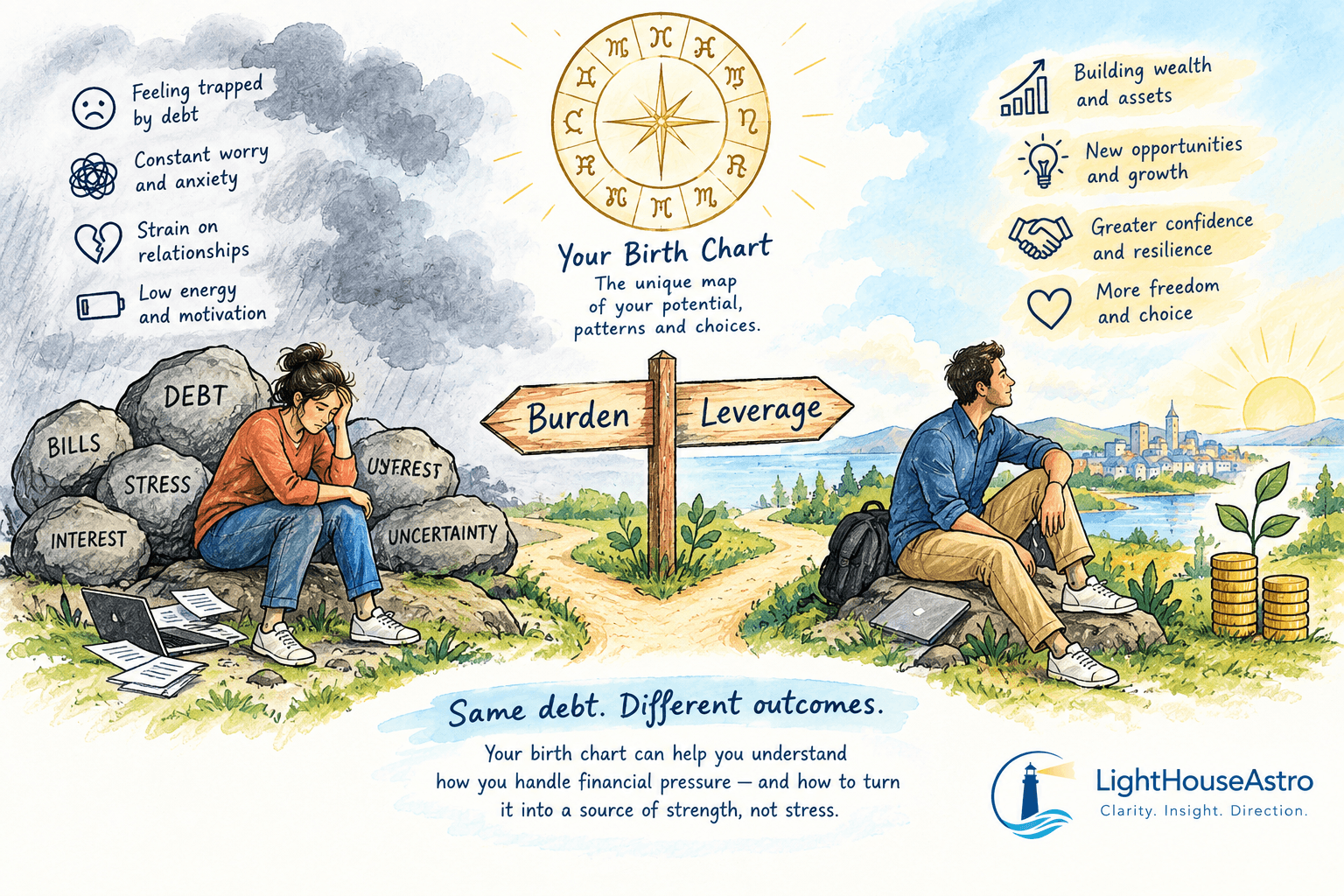
Debt: A Burden or a Leverage?
What Vedic astrology can teach us about debt, financial pressure and the very different ways people approach money
Debt is one of those things most of us have to deal with at some point in life.
A mortgage.
A car loan.
A student loan.
Credit cards.
A business loan.
Sometimes borrowing money helps us move forward. It can help us buy a home, start a business, study, or invest in something that may improve our future.
But sometimes debt becomes a source of constant stress.
Two people can borrow exactly the same amount of money and have completely different experiences.
One person thinks:
"This is a tool. I have a plan, and I'll pay it back."
Another thinks:
"I can't breathe. I need to get rid of this as quickly as possible."
And there is another person who keeps borrowing without really thinking about the consequences.
Why do people approach financial obligations so differently?
This is where Vedic astrology becomes interesting.
Not because your birth chart can tell you whether you should take out a mortgage or use a credit card.
It can't replace proper financial advice.
But Jyotish can offer a fascinating way of looking at how we deal with pressure, responsibility, risk, competition and financial obligations.
And one of the most interesting places to start is the 6th house.
The 6th House: More Than Just Debt
In traditional Jyotish, the 6th house is associated with themes such as debt, obligations, competition, service, conflict, health challenges and the ability to overcome difficulties. Classical texts such as Phaladeepika specifically include debt among the significations of the sixth house.
At first glance, that sounds like a rather unpleasant house.
But there is another side to it.
The 6th house is also an Upachaya house — traditionally associated with areas of life that can develop through effort, experience and persistence.
That makes the 6th house particularly interesting when thinking about debt.
Because debt itself isn't necessarily the whole story.
The more important question may be:
How do you respond when life gives you something you have to manage?
That could be debt.
It could also be a demanding job, a difficult colleague, competition, responsibility, a health challenge or a long-term commitment.
Some people become stronger when faced with pressure.
Others become overwhelmed.
Some avoid problems.
Others attack them immediately.
And some people seem strangely comfortable dealing with difficult situations that would make someone else nervous.
This is where two birth charts can tell very different stories.
Two People. Same Debt. Completely Different Experience.
Imagine two people, James and Sarah.
Both earn £60,000 a year.
Both take out a £250,000 mortgage.
On paper, their financial situation looks almost identical.
But their relationship with the debt is very different.
James
James is naturally comfortable with long-term commitments.
He makes a plan.
He looks at the numbers.
He accepts that the mortgage will take 20 or 25 years to repay.
He doesn't particularly enjoy having debt, but he doesn't constantly worry about it either.
When interest rates rise, he looks at the situation and thinks:
"What can I change?"
He may refinance, reduce other spending, increase his income or find another solution.
Sarah
Sarah experiences the same mortgage very differently.
She checks her bank account constantly.
Every unexpected expense creates anxiety.
She hates owing money to anyone.
She wants to pay the mortgage off as quickly as possible, even if that means sacrificing almost everything else.
Neither approach is automatically right or wrong.
They simply have different relationships with financial responsibility and pressure.
And this is one of the reasons I find astrology fascinating.
The same external event can produce completely different internal experiences.
What If Your Chart Shows How You Handle Pressure?
When I look at the 6th house in a chart, I am not simply asking:
"Does this person have debt?"
That would be far too simplistic.
I am more interested in questions such as:
How does this person deal with obligations?
Do they avoid problems or confront them?
How comfortable are they with competition?
Can they manage pressure?
Do they become stronger through adversity?
Do they take on too much?
Do they worry excessively about what they owe?
Can they turn difficult circumstances into opportunities?
What happens when life doesn't go according to plan?
This changes the conversation completely.
Instead of seeing the 6th house simply as the "debt house", we can see it as part of the bigger story of how a person manages life's battles and obligations.
And that can be surprisingly useful.
Debt Can Be a Burden — But It Can Also Be Leverage
Think about two very different types of borrowing.
Someone uses a credit card to continually pay for things they cannot afford.
The interest accumulates.
The debt grows.
Eventually, the monthly payment itself becomes a problem.
That is debt working against the person.
Now imagine someone borrows money to start a business.
They have a clear plan.
They understand the risks.
They use the money to buy equipment, employ someone or develop a product.
If the business succeeds, the original borrowing may have helped create something much larger.
That is debt being used as leverage.
The important distinction is not simply:
Debt = bad
or
Debt = good
It is:
What is the purpose of the debt, and how capable is the person of managing the obligation?
This is where the 6th house becomes interesting.
A strong 6th-house influence in a chart can, in traditional astrology, be associated with the ability to confront difficulties, competition and obligations.
But that does not mean:
"You have a strong 6th house, so go and borrow lots of money."
Absolutely not.
Your financial picture is much bigger than one house.
The Financial Story Is Spread Across the Chart
If I were looking at someone's financial situation through Jyotish, I would want to understand several parts of the chart.
The 2nd house — What do you have?
The 2nd house is connected with accumulated resources, savings, possessions and financial foundations.
It can tell us something about how a person builds and protects resources.
The 6th house — What do you owe?
This is where debt, obligations and the ability to deal with financial pressure become particularly interesting.
The 10th house — How do you earn?
Career, profession and the way a person engages with the world for work are important when considering whether debt can realistically be managed.
The 11th house — What comes in?
Income, gains and financial growth become relevant here.
The 12th house — What goes out?
Expenses, outgoings and things that drain resources are important considerations.
And sometimes the 8th house becomes relevant when we are dealing with shared finances, loans involving other people, inheritance or financial arrangements that are not entirely under our control.
So a meaningful financial reading isn't:
"Your 6th house says debt."
It is much closer to:
"Let's understand the relationship between what you earn, what you have, what you owe, what you spend and how you respond when financial pressure appears."
That is a much more useful question.
Why Two People Can Have Completely Different Financial Lives
This is perhaps the most valuable part of astrology.
We often assume that people succeed because they have better circumstances.
Sometimes they do.
But sometimes two people have remarkably similar circumstances and make completely different choices.
One person sees a £20,000 loan and thinks:
"This could help me build something."
Another sees the same loan and thinks:
"I'd rather wait five years and save the money."
Another might take the loan without properly considering the repayment.
The numbers are the same.
The psychology is different.
The strategy is different.
The risk tolerance is different.
And the life circumstances are different.
Astrology doesn't remove personal responsibility.
Instead, it can encourage us to ask a more useful question:
"Why do I approach money and responsibility the way I do?"
The 6th House Can Also Teach Us Something About Life
This is why I don't think the 6th house should be labelled simply as a "bad house."
Life is full of things we would rather not deal with.
Bills.
Deadlines.
Difficult conversations.
Competition.
Responsibilities.
Health challenges.
Work pressure.
Family obligations.
The question isn't whether these things will ever appear.
The question is:
What happens when they do?
Some people collapse under pressure.
Some people become incredibly focused.
Some people procrastinate until the problem becomes bigger.
Some people immediately start looking for solutions.
Some people become stronger because life has forced them to develop resilience.
This is one of the deeper lessons of the 6th house.
Difficulty can become a teacher.
In classical Jyotish, the 6th, 8th and 12th houses are traditionally classified as Dusthana houses, while the 3rd, 6th, 10th and 11th are Upachaya houses.
That combination is fascinating.
It reminds us that some areas of life may initially feel difficult but can also become areas where experience, effort and maturity make a significant difference.
A Practical Example
Imagine someone who has accumulated £30,000 of unsecured debt.
Their first reaction is:
"My life is ruined."
But when we step back, there may be several different questions to ask.
How did the debt happen?
Was it lifestyle spending?
An emergency?
A failed business?
Helping family?
A period of unemployment?
Poor planning?
How does the person react to the debt?
Do they avoid opening letters?
Do they become obsessed with it?
Do they create a repayment plan?
Do they look for additional income?
Do they ask for help?
What does the rest of their financial picture look like?
Do they have strong earning potential?
Are their expenses unusually high?
Is their career stable?
Do they have savings?
Are there opportunities to increase income?
This is where a chart can become a tool for self-reflection and strategy, rather than a machine that simply predicts an outcome.
What Can You Actually Do With This Information?
This is where I think astrology becomes much more practical.
If your chart suggests that you tend to avoid uncomfortable financial problems, the solution isn't to blame the chart.
It is to recognise the pattern.
You might decide:
"I need to look at my finances before they become urgent."
If you tend to take on too much responsibility:
"Perhaps I need to stop saying yes to every financial obligation."
If you are naturally comfortable taking risks:
"I need a system that makes sure confidence doesn't turn into overconfidence."
If you become anxious whenever you owe money:
"Perhaps I need to understand whether the debt itself is the problem, or whether uncertainty is the real problem."
These are useful questions.
And they can lead to practical action.
Your Birth Chart Isn't Someone Else's Birth Chart
This is perhaps the biggest reason I don't believe in generic financial astrology.
You can read:
"Jupiter in the 6th house means..."
or:
"Saturn in the 6th house means..."
But that is only the beginning.
The same planet can behave very differently depending on the sign, house ownership, aspects, conjunctions, strength and wider chart.
More importantly, the rest of the chart changes the story.
Two people could both have significant 6th-house influences, yet one might be dealing with business debt while another is dealing with family obligations.
One may have strong earning potential.
Another may have high expenses.
One may be naturally comfortable with risk.
Another may need security.
This is why I prefer to look at astrology as a personal map rather than a collection of universal rules.
So, Is Debt Good or Bad?
Neither.
Debt is a tool.
Like many tools, its impact depends on how it is used.
A mortgage can help someone build a home.
A business loan can help someone build a company.
Education can require borrowing.
But uncontrolled consumer debt can also become extremely stressful and damaging.
And the psychological impact of financial pressure is real. UK research has found associations between financial pressure, borrowing and poorer wellbeing, while recent government research into people with DWP debt found that many debtors were also dealing with wider financial and health-related difficulties.
So astrology should never be used to encourage someone to take financial risks they cannot afford.
Financial decisions require real numbers, proper planning and, when needed, professional financial or debt advice.
Astrology can sit alongside that process as a tool for understanding yourself.
Perhaps the Better Question Isn't "Will I Have Debt?"
A more interesting question is:
"What kind of person am I when life puts me under financial pressure?"
Do I panic?
Do I avoid?
Do I take unnecessary risks?
Do I become focused?
Do I become more disciplined?
Do I look for opportunities?
Do I ask for help?
Do I learn from the experience?
That is a much deeper question than simply asking whether your chart shows debt.
And that is where Jyotish can become genuinely interesting.
Your birth chart isn't simply a prediction of what will happen to you.
It can also be used as a framework for exploring how you respond to what happens to you.
Debt, Life and Your Personal Chart
At LightHouseAstro, I don't use astrology to tell someone:
"You will have debt."
or
"You should take a loan."
Instead, I use the chart to explore the wider pattern — earning, resources, obligations, expenses, career, risk, resilience and timing.
Because two people can stand in almost identical circumstances and experience life completely differently.
And sometimes, understanding that difference is where the real insight begins.
Clarity. Insight. Direction.
Astrology is not financial advice and should not replace regulated financial, legal or debt advice. A personal astrology consultation can be used as a reflective tool alongside practical decision-making.