
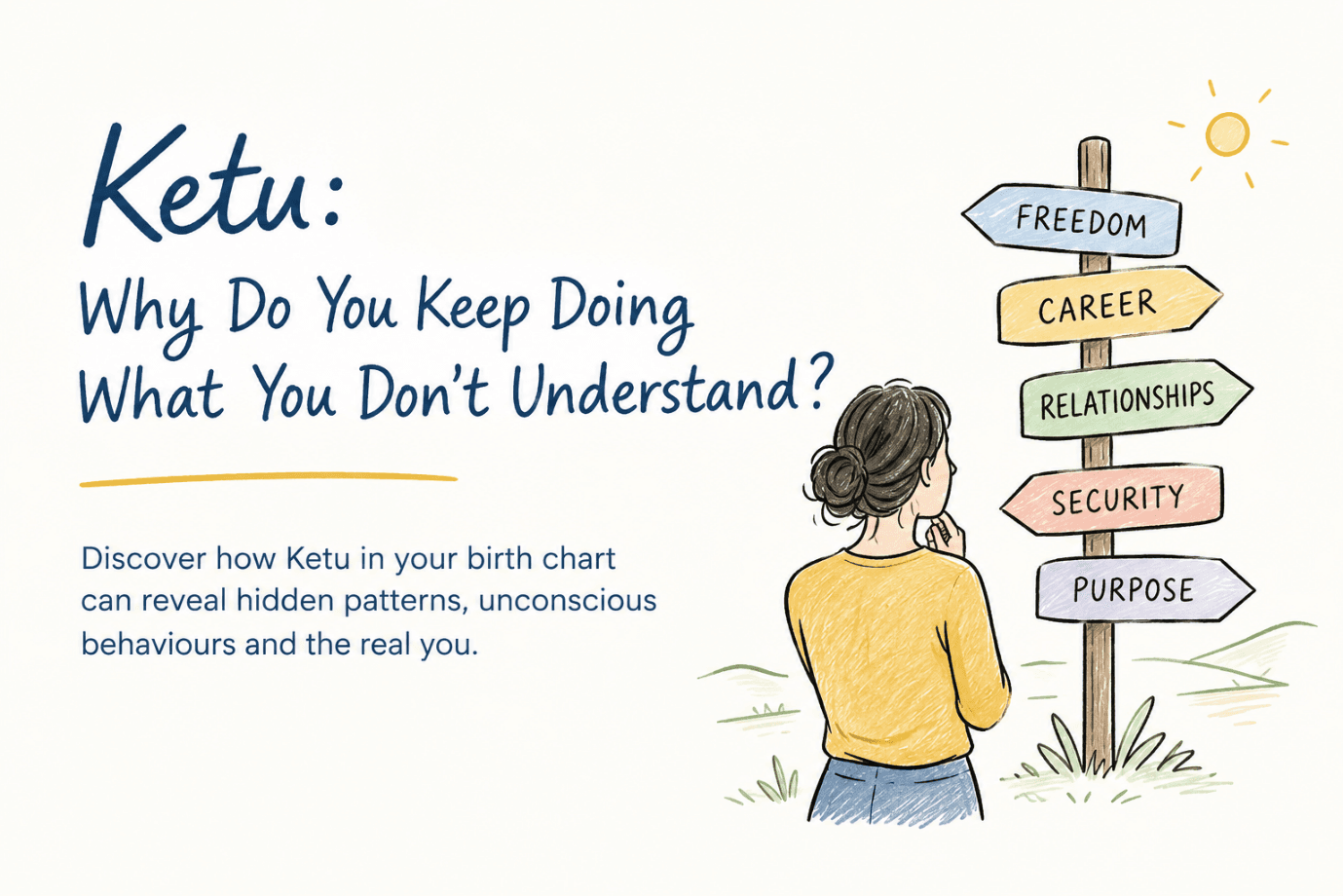
Ketu: Why Do You Keep Doing What You Don't Understand?
The fascinating Vedic astrology idea of unconscious patterns, detachment and karmic familiarity.
There is a sentence I hear occasionally during consultations that always makes me pay attention:
“I don't know why I keep doing this.”
It might be about relationships. It might be about money, work or communication. Sometimes a person knows perfectly well that a particular behaviour isn't helping them, yet somehow the same pattern keeps appearing.
They make the same decision. Have the same reaction. Withdraw at the same point. Lose interest just when things begin to become serious. Or suddenly cut something off without really understanding why.
From a psychological perspective, we might explore habits, conditioning, attachment and past experiences.
From the perspective of Jyotish, there is another fascinating lens.
Ketu.
Ketu is often described as the planet of detachment
If you have ever searched for Ketu online, you will probably find a long list of rather dramatic words:
Separation. Detachment. Confusion. Sudden breaks. Spirituality. Moksha. Past lives.
It can sound rather frightening.
But I think Ketu is much more interesting than that.
In Vedic astrology, Ketu is the South Lunar Node. Like Rahu, it isn't a physical planet. It represents one of the two points where the Moon's orbit intersects the apparent path of the Sun.
Astrologically, Ketu has a very distinctive symbolism.
If Rahu represents what we intensely want to experience, Ketu is often associated with what feels strangely familiar.
And that distinction is incredibly useful.
Rahu wants more. Ketu has had enough.
A simple way I sometimes explain the difference is this:
Rahu says: “I want to experience this.”
Ketu says: “I've seen enough of this.”
This is why Ketu can produce such unusual behaviour.
A person can be extremely capable in an area but strangely uninterested in it.
They may have an opportunity everyone else would love, yet feel no excitement.
They may desperately want something and then, once they get it, suddenly feel empty.
They may become very good at something without consciously understanding why.
Or they may repeatedly walk away from something that appears perfectly good on paper.
Traditional Jyotish can interpret this as an area of deep familiarity or previous karmic experience.
You don't have to accept the idea of reincarnation to find the observation interesting.
The practical question remains:
Why does this particular area of life trigger such a strong and unusual response in me?
That is where astrology becomes a tool for self-exploration rather than simply fortune-telling.
Ketu doesn't always take something away
This is one of the biggest misunderstandings about Ketu.
People often hear:
“Ketu means separation.”
But separation isn't necessarily the whole story.
Sometimes Ketu doesn't remove something from your life.
It removes your attachment to it.
Imagine someone who achieves the career they have worked towards for twenty years.
They get the promotion, the salary, the title and the recognition.
And then something strange happens.
They aren't happy.
They start asking:
“Is this really what I wanted?”
That could be a very Ketu-like question.
The external achievement hasn't disappeared. But the emotional attachment to it has changed.
Sometimes that can be the beginning of a much more meaningful journey.
Look at behaviour, not just events
This is where I find Nadi approaches to Jyotish particularly interesting.
Rather than simply asking:
“What event will happen?”
we can ask:
“What pattern is the person repeatedly demonstrating?”
That is a very different approach.
Suppose Ketu is strongly connected with Mercury, the planet traditionally associated with communication, learning, analysis and intellectual activity.
A superficial interpretation might be:
“You have communication problems.”
But that isn't particularly useful.
I would rather watch the behaviour.
Does the person say very little even when an explanation is needed?
Do they become irritated by repeated questions?
Do they suddenly stop communicating?
Do they understand something intuitively but struggle to explain it?
Do they lose interest once they have figured something out?
Do they mentally move on while everyone else is still discussing the subject?
Now we have something much more interesting.
We are no longer simply saying, “Ketu affects Mercury.”
We are asking:
“Why does this person behave this way around communication and thinking?”
That is where a birth chart can become the starting point for a much deeper conversation.
Ketu and relationships
Consider Ketu connected with Venus, traditionally associated with relationships, affection, beauty, pleasure and enjoyment.
Again, it would be too simplistic to say:
“Ketu with Venus means relationship problems.”
Real charts are much more nuanced.
A person may genuinely want a relationship but simultaneously feel uncomfortable with emotional closeness.
They may enjoy romance but lose interest when the relationship becomes predictable.
They may be attracted to beautiful things but feel strangely detached from material comfort.
Or they may experience a recurring feeling of:
“I thought this would make me happy. Why doesn't it?”
This doesn't automatically mean the relationship will fail.
It may simply suggest that the person's relationship with love, pleasure or attachment deserves deeper examination.
The house, sign, dispositor, aspects, timing and wider planetary pattern all matter.
One placement should never be treated as a verdict.
Ketu and Mars: “Why did I just do that?”
Mars represents action, drive, courage, competition and the instinct to act.
When Ketu becomes strongly connected with Mars, the behaviour can sometimes become unusually sharp or instinctive.
Some people may act extremely decisively in situations where others hesitate.
Others may lose interest in competition once they have proved themselves.
Someone may react very quickly and only afterwards think:
“Why did I react like that?”
Again, this isn't automatically negative.
In some circumstances, the combination can correspond with extraordinary focus, courage or the ability to act without excessive hesitation.
But the same quality can become problematic when there is no time between emotion and action.
The important question is not:
“Is Ketu with Mars good or bad?”
It is:
“How does this combination express itself in this particular person?”
Ketu and Saturn: duty without attachment
Saturn is associated with responsibility, structure, discipline, persistence and long-term commitments.
Ketu can introduce detachment into these areas.
One person might carry enormous responsibility but feel emotionally disconnected from it:
“I do it because somebody has to.”
Another might repeatedly struggle to maintain long-term structures.
Work. Career. Routine. Commitments. Projects.
There can sometimes be a strange relationship with responsibility — either too much duty or an urge to escape it.
Once again, the entire chart matters.
Astrology isn't a collection of isolated formulas.
And then there is Ketu and the Moon
This is perhaps one of the most subtle combinations to explore because the Moon in Jyotish is closely connected with the mind, emotional responses, habits and our subjective experience.
With a strong Ketu-Moon connection, some people can experience periods of profound emotional withdrawal.
They may care deeply. They may love deeply.
But once something crosses an internal boundary, they can suddenly detach.
Someone close to them might say:
“How can you switch off so quickly?”
And the person may genuinely struggle to explain it.
From their perspective, the decision may not have happened suddenly at all.
They may feel:
“I had already emotionally left a long time ago.”
That difference between the visible event and the invisible internal process is precisely why I find Ketu so fascinating.
The Ketu question
When I study Ketu in a chart, I don't want to ask only:
“What will Ketu take away?”
I want to ask:
“What feels strangely familiar to this person?”
And then:
“What do they repeatedly do without fully understanding why?”
That could reveal much more than a prediction.
Perhaps someone repeatedly chooses emotionally unavailable partners.
Perhaps someone keeps changing careers just as things become stable.
Perhaps someone continually rejects opportunities.
Perhaps someone is exceptionally skilled at something but doesn't value that skill.
Perhaps someone repeatedly withdraws when they need to communicate most.
These patterns are worth exploring.
The Nadi perspective: follow the chain
This is where more advanced Nadi approaches become particularly interesting.
In traditions associated with Bhrigu Nadi and Agastya Nadi, practitioners may examine planetary relationships and sequences rather than interpreting one planet in isolation.
For a Ketu analysis, I would look at things such as:
Which house Ketu occupies
Which sign it occupies
The sign lord
Planets connected with Ketu
The houses those planets occupy
Planetary aspects and relationships
The broader planetary sequence
Most importantly, how these themes are reflected in the person's actual life
The chart provides the framework.
The person's life provides the evidence.
This last part is important.
A good astrologer shouldn't force a person into a textbook interpretation.
The interpretation should be tested against reality.
What if your behaviour is the clue?
This is perhaps my favourite way of looking at Ketu.
We often wait for something dramatic to happen before we pay attention.
A relationship ends.
We lose a job.
We move country.
We suddenly change direction.
And then we ask:
“Why did this happen?”
But sometimes the clues were there much earlier.
They were hidden in our behaviour.
The repeated reaction.
The recurring dissatisfaction.
The inexplicable withdrawal.
The thing we keep doing even though we know exactly where it leads.
Ketu may be worth exploring before the event, not just after it.
A small experiment you can try
You don't need to be an astrologer to start thinking about this.
Ask yourself:
What do I repeatedly do that I don't fully understand?
Then ask:
When does it usually happen?
What triggers it?
What am I trying to escape — or protect?
What happens immediately before I withdraw?
Does this pattern appear in more than one area of my life?
And finally:
What if this isn't a random habit, but a clue?
This is where your birth chart can become interesting.
Not because it gives you a simple answer.
But because it can give you another perspective from which to investigate the question.
Ketu isn't something to fear
I don't see Ketu as a planet that comes into your life simply to take things away.
Sometimes Ketu creates separation.
Sometimes it creates detachment.
Sometimes it creates confusion.
But sometimes that detachment is exactly what allows us to discover that we were holding onto something that no longer served us.
Ketu can ask a difficult question:
“What are you doing simply because you are familiar with it?”
And perhaps an even more difficult one:
“What would happen if you stopped?”
Understanding your Ketu
A birth chart can contain patterns that aren't immediately obvious when you're living inside them.
That's one of the reasons I find astrology so valuable.
It gives us the opportunity to step outside our everyday experience and look at ourselves from another perspective.
At LightHouseAstro, I don't believe in frightening people with statements such as “Ketu will destroy this area of your life.”
I would much rather explore:
What does Ketu represent in your chart?
Where might you already be experiencing detachment or unusual familiarity?
What patterns keep repeating?
What strengths might be hidden inside that pattern?
And perhaps most importantly:
What can you do with that awareness?
Because understanding a pattern doesn't mean you're destined to repeat it.
Awareness creates choice.
And choice is where the real conversation about astrology begins.
A final thought
You don't have to believe in past lives to find Ketu interesting.
You don't even have to believe that astrology can predict your future.
You can simply treat your birth chart as a framework for asking better questions about yourself.
If Ketu can help us notice the parts of our behaviour that we don't fully understand, perhaps its greatest gift isn't separation at all.
Perhaps it is awareness.
And sometimes, seeing a pattern clearly is the first step towards changing it.
Clarity. Insight. Direction.