
Is Astrology Still Relevant in Modern Life?
Perhaps the real question isn't whether astrology can predict your future, but whether you have any other way of understanding the road ahead.
Most people in the West have encountered astrology at some point.
Perhaps it was the horoscope at the back of a magazine:
"Leo — an exciting opportunity is coming your way this week."
Or a social media post telling you what your star sign says about your love life.
For many people, that is astrology. And I completely understand why.
After decades of being presented through newspapers, entertainment programmes and social media, astrology has become associated with fun, personality quizzes and predictions.
But there is another tradition that I believe is worth discovering. Jyotish.
The word is traditionally associated with light or illumination, and Jyotisha is one of the six Vedangas, the traditional auxiliary disciplines associated with the Vedic tradition.
I don't see Jyotish as a form of entertainment.
I see it as a way of bringing light to questions that are otherwise very difficult to answer.
And strangely enough, I think that makes it particularly relevant to modern life.
We Have Forecasts for Everything — Except Ourselves
Imagine you are running a business.
Before making an important decision, you might look at:
Market forecasts
Financial projections
Competitor activity
Economic conditions
Customer behaviour
Regulatory changes
Risk assessments
You wouldn't normally say:
"Let's just see what everyone else is doing and hope it works."
Yet this is remarkably close to how many of us make decisions about our own lives.
We grow up watching other people. We see what our parents consider successful.
We copy our friends. We follow what society tells us we should want. We choose our education, career, relationships and lifestyle based partly on what appears to be working for everyone else.
Then, somewhere around our 30s, 40s or 50s, many of us suddenly ask:
"Is this actually the life I wanted?"
The Strange Problem of Modern Life
We have more choices than ever. But more choice doesn't necessarily make life easier.
The latest figures from the UK's Office for National Statistics show that during October–December 2025, 23.6% of adults reported high levels of anxiety. Around 1 in 20 reported low life satisfaction, and 8.1% reported low happiness.
Globally, the picture is also significant.
The World Health Organization estimates that around 1 in 7 people worldwide live with a mental disorder, with anxiety and depressive disorders among the most common.
And Gallup's 2025 global emotional health report found that in 2024, 39% of adults worldwide experienced a lot of worry on the previous day, while 37% experienced a lot of stress. Both measures remain higher than they were a decade ago.
These statistics don't prove that astrology can solve these problems. They do, however, tell us something worth thinking about.
Modern life is not necessarily making it easier for us to know what to do with our lives.
What If Success Isn't the Same for Everyone?
This is where my interest in Jyotish begins.
Imagine two people.
One person thrives in a competitive corporate environment. They love targets, responsibility and achievement.
Another person becomes miserable in exactly the same environment. They may be creative, independent and happiest when working on something meaningful.
Who is successful?
We often answer that question by looking at income, job titles, houses, cars or social status.
But perhaps success should begin with a different question:
What does a successful life actually mean to you?
That sounds like a simple question. It isn't.
Most of us were never really taught how to answer it.
Your Birth Chart Starts With You
This is one of the things I find fascinating about Jyotish. It doesn't begin by asking you to fit into a general description of what a successful person should be. It begins with your birth details. Your birth chart is interpreted as a unique pattern of planetary positions at the time of your birth.
Within the Jyotish tradition, astrologers examine this pattern through different factors to explore themes such as personality, relationships, career, family, strengths, challenges and the timing of different periods of life. This doesn't mean that a chart should be treated like a machine that predicts every event. I don't believe that.
For me, the value is in asking better questions.
What If You Could Ask Better Questions?
Instead of:
"Will I be successful?"
You might ask:
"What kind of success actually suits me?"
Instead of:
"When will I get promoted?"
You might ask:
"What kind of work allows me to use my natural strengths?"
Instead of:
"Will I get married?"
You might ask:
"What kind of relationship helps me grow?"
Instead of:
"Will I be rich?"
You might ask:
"What is my relationship with money, security and ambition?"
And instead of:
"Will something bad happen?"
You might ask:
"What periods of my life may require more patience, preparation or inner work?"
For me, this is where astrology becomes much more interesting.
Life Has Seasons
One of the most useful concepts in Jyotish is the importance given to timing.
Life doesn't remain the same. There are periods when we naturally want to build.
There are periods when we are pushed to change. There are periods when career takes centre stage. There are periods when relationships become more important. And there are periods when life seems to turn our attention inward. Sometimes we fight these changes because we think something has gone wrong. But perhaps the question should be:
"What is this period of my life asking from me?"
That is a very different way of looking at life.
The Chart Is Not Just About Your Problems
I also think modern astrology sometimes focuses too heavily on what's wrong.
"You have a difficult Saturn." "Rahu is causing problems." "Your marriage house is afflicted."
That approach can create unnecessary fear. When I look at a chart, I want to understand the whole person.
Where are your natural strengths?
Where do you have resilience?
What environments help you flourish?
What patterns create friction?
What might you need to become more conscious of?
A weakness isn't necessarily a sentence.
Sometimes it is simply an area where awareness can make a difference.
You Don't Need Astrology to Live Your Life
This is important. You don't need astrology.
And I don't believe anyone should surrender their decisions to an astrologer. If you're changing careers, you should consider your skills, finances and responsibilities. If you're making an investment, seek appropriate financial advice.
If you're struggling with your mental health, speak to a qualified healthcare professional.
Astrology shouldn't replace expertise.
It can sit alongside it.
Think of it as another perspective—a way of stepping back from the immediate noise and looking at the bigger picture.
From Information to Insight
We live in an extraordinary age. If we have a question, we can Google it. We can ask an AI.
We can watch ten videos about it. We can read hundreds of opinions. But eventually we face a problem:
Which of all this information actually applies to me?
That's where I believe a personal Jyotish consultation is different from a generic horoscope. A horoscope gives you a general message. A consultation begins with your life.
Your chart. Your circumstances. Your questions. Your concerns. Your stage of life.
And most importantly, your choices.
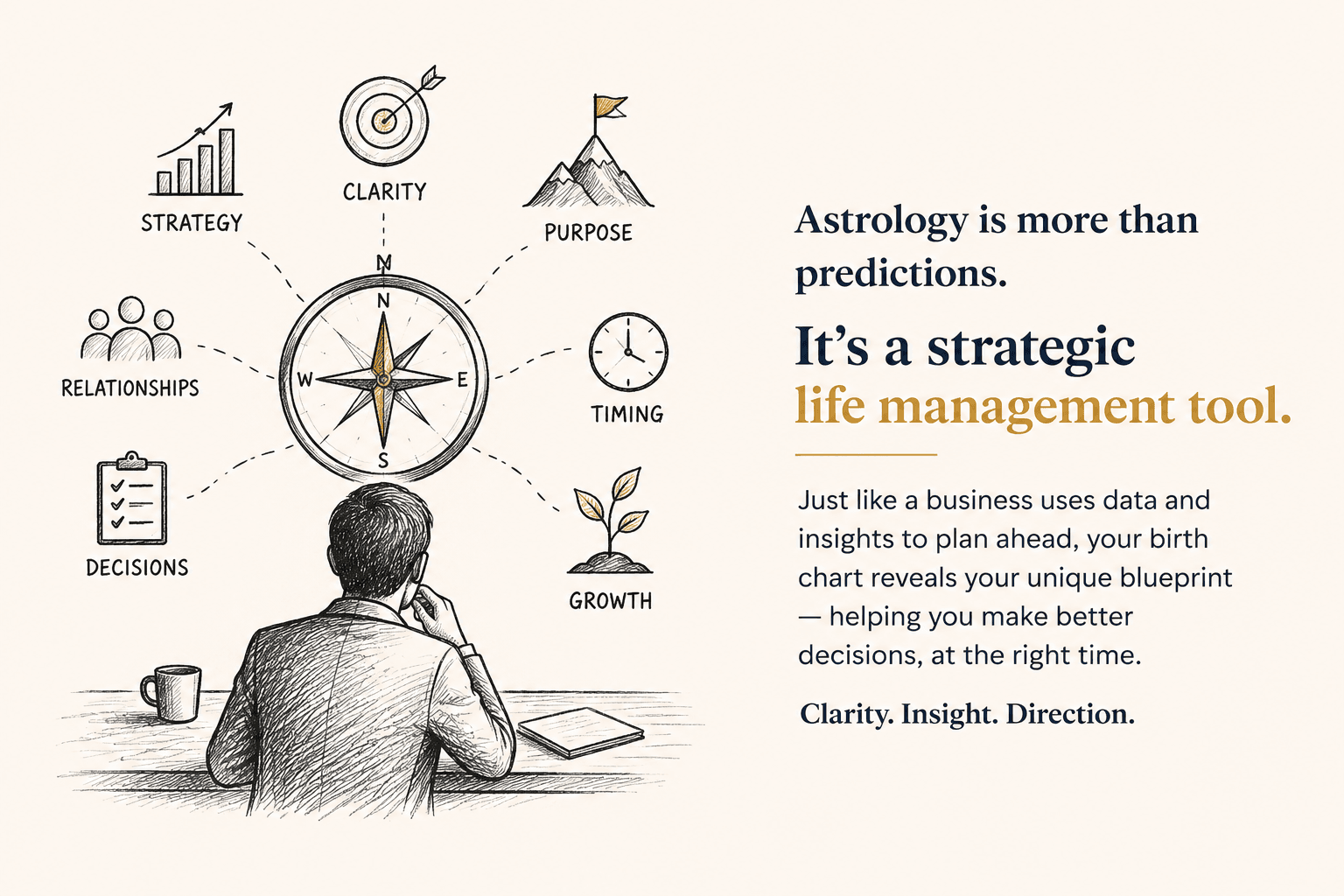
Perhaps We Need a Life Compass
I don't see Jyotish as a crystal ball. I see it more like a map. A map doesn't tell you that you must take a particular road. It doesn't remove the traffic. It doesn't guarantee that you will enjoy every part of the journey. But it can show you where you are. It can help you see the wider landscape. And sometimes, that is exactly what we need. Because when you're standing in the middle of your own life, it's surprisingly difficult to see the whole picture.
So, Is Astrology Relevant Today?
Perhaps more than ever.
Not because we need another source of predictions. We already have plenty of those. We need something that encourages us to pause and ask better questions.
What am I actually trying to achieve?
What does success mean to me?
What are my natural strengths?
Where am I creating unnecessary friction in my life?
What kind of relationships help me grow?
Is this the right time to push forward—or to step back and reassess?
What kind of life would genuinely make me feel fulfilled?
These are not questions that a daily horoscope can answer.
They are personal questions.
And that is exactly why I believe they deserve a personal approach.
Clarity. Insight. Direction.
This is why I created LightHouseAstro.
I don't want to tell people how they should live.
I want to help them understand themselves a little better so that they can make their own decisions. For me, that is the real potential of Jyotish in modern life.
Not entertainment.
Not fear.
Not telling someone that their future is fixed.
But helping someone step back from the noise of everyday life and ask:
"What is my life actually asking of me?"
Perhaps you don't need someone to tell you what your future will be.
Perhaps you need a little more Clarity. Insight. Direction.
And sometimes, that is enough to take the next step.
A note on astrology and wellbeing
The wellbeing statistics in this article describe the challenges people face; they do not demonstrate that astrology can treat anxiety, depression or other mental-health conditions. Effective professional treatments exist, and astrology should never replace appropriate medical or psychological support.